SAP-C02 Is Retiring November 16, 2026 — Everything You Need to Know About SAP-C03
AWS just opened SAP-C03 registration (October 27). SAP-C02 retires November 16. Here's what's new in the updated Solutions Architect Professional exam and the exact decision rule for which version to take.
AWS Training and Certification announced in September 2026 that the AWS Certified Solutions Architect – Professional exam is being updated from SAP-C02 to SAP-C03. Registration for SAP-C03 opened October 27, 2026, and SAP-C02 retires November 16 — just six weeks away.
If you are currently studying for the Professional-level Solutions Architect, or deciding whether to pursue it, here is everything you need to know now.
The Timeline, Clearly
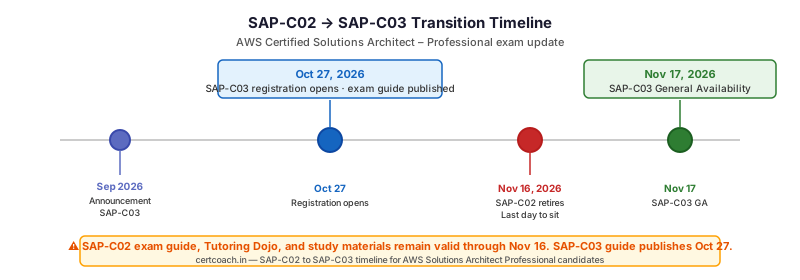
| Date | Event |
|---|---|
| September 2026 | AWS announces SAP-C03 |
| October 27, 2026 | SAP-C03 registration opens; official exam guide published |
| November 16, 2026 | SAP-C02 retires — last day to sit current version |
| November 17, 2026 | SAP-C03 general availability begins |
You have 42 days from today (October 5) to take SAP-C02 if that is your plan.
What Is Changing: SAP-C03's Five Domains
The full exam guide published October 27. Based on AWS's announcement, SAP-C03 restructures the exam around five updated domains:
- Cloud-native architecture design and implementation — the new leading domain, with increased weight on cloud-native patterns, microservices, containers (ECS, EKS), and serverless.
- Security, compliance, and governance — expanded to include DevSecOps (policy-as-code, AWS Organizations SCPs, supply chain security) and post-quantum cryptography preparedness.
- Cost-optimized architecture design — retained from SAP-C02, covering Reserved Instances, Savings Plans, Compute Optimizer, and cost allocation patterns.
- Resilience, migration, and business continuity — expanded to include resilience engineering (chaos engineering, game day exercises, multi-region active-active), alongside the SAP-C02 migration and DR content.
- Operational excellence and automation — retained, covering IaC (CloudFormation, CDK), CI/CD pipelines, observability, and automated remediation.
What Is Actually New
The SAP-C03 announcement specifically called out these additions that go beyond SAP-C02:
- Generative and agentic AI design — designing multi-agent architectures on Amazon Bedrock, choosing between RAG and fine-tuning, integrating AI agents into enterprise architectures. If you passed the AIF-C01 or have studied generative AI services, this content will feel familiar. (See our RAG vs fine-tuning guide for the foundational concepts.)
- Resilience engineering — beyond RTO/RPO and DR tiers, SAP-C03 tests how to design for failure proactively: fault injection experiments using AWS Fault Injection Service, multi-region active-active architectures, and defining recovery runbooks.
- Post-quantum cryptography — awareness of AWS's post-quantum TLS implementations and the services where quantum-resistant algorithms are available. This is an awareness-level topic, not a deep cryptography exam.
- DevSecOps — integrating security into CI/CD pipelines using CodePipeline, AWS Security Hub findings as pipeline gates, and policy-as-code with AWS Config rules and SCPs.
What Is Staying the Same
Do not let the new content distract you from the SAP-C02 core that SAP-C03 still tests heavily:
- Multi-account strategies with AWS Organizations, Control Tower, and Landing Zone
- Advanced networking: Transit Gateway, Direct Connect redundancy, VPN failover, inter-region routing
- Data migration: Database Migration Service, Snowball family, DataSync
- Disaster recovery: backup and restore, pilot light, warm standby, multi-site active-active — and their cost/RTO trade-offs
- Cost optimization: right-sizing, Reserved Instance strategies, Savings Plans, multi-tier purchasing models
- Identity: IAM roles across accounts, Cognito for federated access, AWS IAM Identity Center
If you have been studying SAP-C02, your preparation is roughly 70–75% transferable to SAP-C03. The new domains add content, they do not replace the foundation.
The Decision Rule: Which Version Should You Take?
Take SAP-C02 before November 16 if:
- You are 60% or more prepared based on practice-test scores.
- You can realistically schedule the exam in the next six weeks around your work and life commitments.
- You do not want to study the new SAP-C03 material (agentic AI, resilience engineering, DevSecOps additions) from scratch.
The SAP-C02 credential you earn has exactly the same market value as SAP-C03. Employers see "AWS Certified Solutions Architect – Professional" — they do not see the version number.
Plan for SAP-C03 on or after November 17 if:
- You are less than 60% prepared on practice tests.
- You cannot commit to six weeks of focused prep alongside your other responsibilities.
- You are starting from zero on Professional-level content.
- You want to study the AI and resilience engineering additions, which are genuinely high-value skills beyond the certification itself.
Avoid the "I'll take SAP-C02 just to have it done" trap: the Professional exam has a 75% pass rate on first attempt — lower than most AWS exams. Sitting underprepared to beat the retirement date costs you the $300 exam fee, a retest wait period, and the morale hit of a failed attempt. If you need more than six weeks to prepare comfortably, the credential is worth waiting for.
Where to Start
Whether you are targeting SAP-C02 now or SAP-C03 after November 17, the best first step is knowing which of the exam domains you are already strong in versus which need the most work. Take the free 10-question diagnostic for Solutions Architect to get a baseline across the core architecture domains — if you are coming from the Associate level, this tells you where your Associate knowledge holds and where you have Professional-level gaps to close.
The SAA-C03 practice question set covers the foundational architecture topics that underpin both exam versions. Professional-level prep builds on top of that foundation — if your Associate-level networking, storage, and IAM concepts are solid, the Professional content becomes pattern-matching at a higher level of scenario complexity.