CloudFront vs. Global Accelerator: The AWS Edge Performance Decision the SAA-C03 Tests Every Time
CloudFront and Global Accelerator both sit at the AWS network edge, but they solve completely different problems — and the SAA-C03 exploits every difference. Here's the complete guide to choosing correctly on exam day.
Here is the scenario type you will almost certainly encounter on the SAA-C03:
A company runs a multiplayer gaming application deployed in two AWS regions. Players connect over UDP. The team needs global users to reach the nearest healthy region with minimal latency. If a region fails, traffic must reroute to the surviving region within 30 seconds — before players notice. Which service should the solutions architect use to meet these requirements?
If your instinct is "CloudFront, because it's the AWS global edge service" — you're in the right neighbourhood but picking the wrong tool. CloudFront is an HTTP/HTTPS CDN. It does not support UDP. Global Accelerator is the answer here, and the SAA-C03 sets up this exact confusion on purpose.
The cloudfront vs global accelerator question sits at the intersection of two exam domains — Design High-Performing Architectures and Design Resilient Architectures — and it appears in multiple question flavours: caching, protocol support, static IPs, and failover speed. This guide gives you the mental model to separate them cleanly and arrive at the right answer regardless of which angle the exam attacks from.
What These Services Actually Are
Before comparing mechanics, fix the fundamental shape of each service in your mind:
Amazon CloudFront is a Content Delivery Network (CDN). Its job is to cache HTTP and HTTPS responses at edge locations physically close to users, so the next request for the same content is served from cache instead of travelling all the way back to the origin (S3, ALB, EC2, or any HTTP server). Caching is CloudFront's reason for existing. Every major feature — cache behaviours, cache invalidation, TTL settings, Lambda@Edge, origin shield — is designed around making cached content delivery faster, cheaper, and more controllable.
AWS Global Accelerator is a network routing and acceleration service. Its job is to route TCP and UDP traffic through the AWS private global backbone instead of the public internet. When a user connects, their traffic enters the AWS network at the nearest edge location via anycast — both of Global Accelerator's two static IP addresses are simultaneously announced from every edge location worldwide, and BGP directs the client to the geographically closest one. From there, the traffic travels the rest of the way to your endpoint (ALB, NLB, EC2 instance, or Elastic IP) over AWS's private, low-latency backbone. Global Accelerator does not cache anything. It has no concept of a cache hit or a cache miss. It is a network-layer router.
That distinction — CloudFront = caching CDN, Global Accelerator = network router — is the load-bearing beam the exam builds every question on.
CloudFront vs. Global Accelerator: The Core Differences
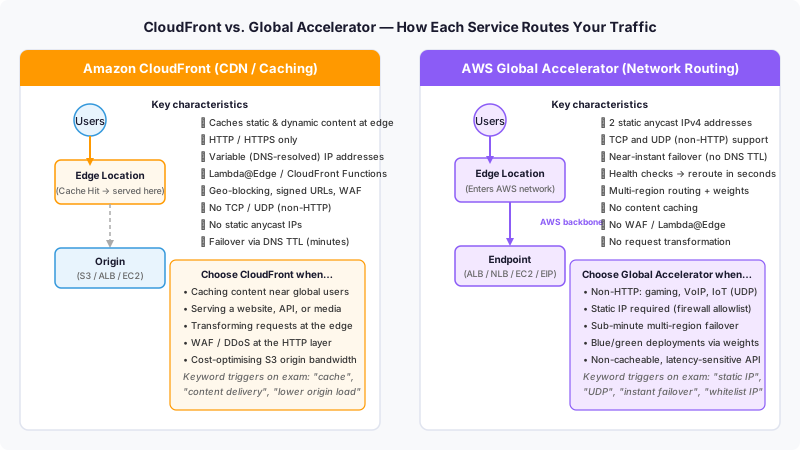
Caching vs. Routing
CloudFront caches objects — HTML pages, images, video segments, API responses — at edge locations. A user in Mumbai requesting a product image stored in an S3 bucket in us-east-1 gets the image from the Mumbai edge location on the second request, with single-digit millisecond latency. The origin doesn't receive that second request at all.
Global Accelerator does none of this. Every request travels through the edge location and continues to your endpoint. The value is that "through the edge" part: the public internet segment is shortened to the user-to-edge hop, and the remaining (longer) path uses AWS's private backbone, which has lower jitter and higher reliability than the public internet.
Exam signal: If the scenario mentions "reduce origin load," "serve cached content," or "reduce bandwidth costs," the answer is CloudFront. If the scenario says the application is "non-cacheable" (unique per-user API calls, real-time data, live game state), Global Accelerator is the candidate.
Protocol Support: HTTP Only vs. TCP + UDP
CloudFront supports HTTP and HTTPS exclusively. It is an application-layer (Layer 7) service. You configure cache behaviours on URL paths, query strings, headers, and cookies. It knows what an HTTP response looks like. It does not know what a UDP datagram looks like and cannot handle one.
Global Accelerator works at the transport layer (Layer 4). It routes TCP and UDP packets without inspecting application-level content. This is why it can accelerate a game server using UDP, a VoIP system using RTP over UDP, an IoT fleet using MQTT over TCP, or any other non-HTTP protocol. AWS Global Accelerator documentation lists ALB, NLB, EC2 instances, and Elastic IPs as valid endpoint types — and only NLB and EC2/EIP can terminate non-HTTP traffic.
Exam signal: The word UDP in any question eliminates CloudFront immediately. The SAA-C03 knows you might miss this, so it makes UDP the only detail that separates the correct answer from a very plausible CloudFront distractor.
Static Anycast IPs vs. Variable DNS IPs
This is the most underestimated difference on the exam.
Global Accelerator provisions two static anycast IPv4 addresses for the lifetime of your accelerator. These IPs never change. You can add them to a corporate firewall allowlist, hand them to a banking partner who needs to whitelist your IPs, embed them in IoT device firmware that doesn't support DNS lookup, or include them in a security audit that asks for fixed IP ranges. Once set, they remain valid — no DNS record to update, no IP rotation to track.
CloudFront's IP addresses are variable and DNS-resolved. CloudFront issues your distribution a hostname like d1234abcd.cloudfront.net. The IP addresses behind that hostname change as AWS routes clients to different edge locations. You cannot reliably whitelist CloudFront IPs in an external firewall (though AWS does publish the CloudFront IP ranges, the list is large and changes frequently).
Exam signal: The phrase "static IP" or "IP whitelist" or "firewall allowlist" in an exam question is a near-certain pointer to Global Accelerator.
Failover Speed: DNS TTL vs. Network Reroute
Both services have health checks and route traffic away from unhealthy endpoints. The difference is how fast and at what layer.
CloudFront uses origin health checks, but failover for traffic reaching a failing origin is governed by the OriginConnectionTimeout, OriginResponseTimeout, and your DNS record TTLs. When a CloudFront distribution fails over to a secondary origin or the routing changes, client DNS resolvers may hold the old IP in cache for the TTL duration — potentially minutes.
Global Accelerator continuously monitors your endpoints with health checks. When an endpoint fails, Global Accelerator reroutes traffic at the network layer — it stops announcing that endpoint and shifts anycast routing — without any DNS change or TTL wait. AWS documents near-instant failover: roughly 30 seconds or less from endpoint failure to traffic rerouting. No client needs to re-resolve a DNS name. The two static anycast IPs continue to work; they simply now route to a different, healthy region.
Exam signal: The phrase "failover within seconds" or "without waiting for DNS" is a strong pointer to Global Accelerator. When the scenario describes a multi-region active-active or active-standby architecture with strict recovery time objectives, Global Accelerator is usually the correct answer.
Shared Traits (That Don't Help You Choose)
Both services:
- Sit at the AWS network edge
- Integrate with AWS Shield Standard for DDoS protection by default
- Work with multiple AWS regions simultaneously
- Can be used for global audiences
These common traits are distractor ammunition — the exam presents both services as "global edge services" and tests whether you can distinguish what kind of edge work each one does.
The Comparison Table
| Dimension | Amazon CloudFront | AWS Global Accelerator |
|---|---|---|
| Primary function | Caching CDN (Layer 7) | Network routing/acceleration (Layer 4) |
| Protocols | HTTP / HTTPS only | TCP and UDP (any application) |
| Caching | ✅ Yes — core feature | ❌ No caching at all |
| IP addresses | Variable (DNS-resolved) | 2 static anycast IPv4 IPs |
| IP whitelisting | ❌ Not reliably possible | ✅ Yes — IPs never change |
| Failover speed | DNS TTL-dependent (minutes) | ~30 seconds, network-layer reroute |
| Lambda@Edge | ✅ Yes | ❌ No |
| WAF integration | ✅ Yes | ❌ No |
| Geo-restriction | ✅ Yes | ❌ No |
| Signed URLs/cookies | ✅ Yes | ❌ No |
| Endpoint types | Origins: S3, ALB, HTTP servers | ALB, NLB, EC2, Elastic IP |
| Pricing model | Per GB transferred + HTTP requests | Per accelerator-hour + GB transferred |
| DDoS protection | Shield Standard included | Shield Standard included |
Four Exam Scenarios, Decoded
Scenario 1: The Multiplayer Game (UDP)
A company runs a real-time multiplayer game. The game client communicates with backend game servers in us-east-1 and eu-west-1 using UDP. Players are distributed globally and the team wants to minimise latency and ensure traffic automatically routes to the healthy region if one fails. Which service should the solutions architect configure?
Correct answer: AWS Global Accelerator.
Working through the requirements:
- "UDP" — CloudFront eliminated immediately. Global Accelerator handles Layer 4 TCP and UDP.
- "Minimise latency globally" — anycast routes clients to the nearest edge; backbone carries traffic the rest of the way.
- "Automatically routes to healthy region" — Global Accelerator's health checks and network-layer failover satisfy this.
Why not CloudFront? CloudFront cannot process UDP datagrams. This is a hard technical disqualification, not a preference.
Scenario 2: The Static-Asset Website (Caching)
A company hosts a marketing website on Amazon S3. Pages include large product images, CSS bundles, and video trailers. The operations team wants to reduce S3 data transfer costs and minimise page load times for users across Asia, Europe, and North America. Which service best meets these requirements?
Correct answer: Amazon CloudFront.
Working through the requirements:
- "Reduce S3 data transfer costs" — CloudFront caches objects at edge locations; S3 is billed only for the first (origin) request per TTL window. This is CloudFront's core origin-offload value.
- "Minimise page load times" — cache hits are served from the nearest edge with single-digit millisecond latency.
- Nothing about UDP, static IPs, or sub-minute failover.
Why not Global Accelerator? Global Accelerator delivers no caching benefit. Every request still travels to the origin. It's also more expensive per GB than CloudFront for HTTP workloads and doesn't have the origin-offload economics.
Scenario 3: The Corporate Partner Integration (Static IP)
A financial services company exposes an internal HTTPS API to a small set of corporate partners. Each partner allows inbound traffic only from pre-approved IP addresses via their enterprise firewalls, and they cannot accept IP range changes more than once per year. The company wants to deploy the API with low latency for global partners. Which service should the solutions architect recommend?
Correct answer: AWS Global Accelerator.
Working through the requirements:
- "Pre-approved IP addresses" and "cannot accept IP range changes" — this is the static IP requirement. Global Accelerator's two anycast IPs never change; partners whitelist those two IPs once and are done.
- CloudFront's IPs are variable and the range list is large and frequently updated — it cannot meet the partner's constraint.
- "HTTPS API" — both services support HTTPS, so protocol is not the differentiator here; the static IP is.
This is a common trap question. The service is HTTP, which might make you reach for CloudFront, but the static-IP constraint uniquely matches Global Accelerator.
Scenario 4: The Multi-Region Failover SLA (Speed)
A healthcare company runs a critical patient-monitoring application in us-east-1 with a failover replica in us-west-2. Their SLA requires that if the primary region fails, user traffic must be routed to the secondary region within 60 seconds. Which service provides the fastest and most reliable failover mechanism?
Correct answer: AWS Global Accelerator.
Working through the requirements:
- "Within 60 seconds" — Global Accelerator's health checks detect failures and reroute at the network layer in roughly 30 seconds. No DNS TTL to expire.
- Route 53 health checks + failover routing are another option, but DNS propagation depends on TTL settings and client resolver caches — it can easily exceed 60 seconds even with a low TTL.
- CloudFront's failover between origins is also DNS-based and cannot guarantee 60-second RTO.
Note: the question doesn't mention UDP or static IPs — the discriminator here is purely failover speed.
Can You Use Both Together?
Yes, and the exam sometimes tests this. A common architecture:
- CloudFront in front of an ALB — CloudFront caches static content and compresses/transforms responses at the edge for HTTP clients.
- Global Accelerator in front of a separate NLB — for the same application's non-HTTP traffic (e.g., a WebSocket or UDP path).
More often, the SAA-C03 places them as competing options in the same question rather than as co-components — forcing you to choose. But knowing they can coexist tells you the exam isn't just pattern-matching "use one or the other always"; it's testing whether you understand why you'd need each.
Exam Traps and How to Dodge Them
Trap 1: "Edge" = "CloudFront." Both services use the AWS edge network. Global Accelerator also routes through edge locations. The word "edge" alone doesn't determine the answer. Look for the function: caching vs. routing.
Trap 2: The HTTPS question that's actually about static IPs. You see "the company needs fast HTTPS API delivery for global users" and assume CloudFront. But if the next sentence says "partners require a stable IP to whitelist," the answer flips to Global Accelerator. Read the entire scenario before eliminating options.
Trap 3: "CloudFront handles failover." CloudFront has origin failover (primary and secondary origin groups), but failover depends on DNS TTL. When the SLA asks for seconds-level recovery, the question is testing Global Accelerator's network-layer rerouting, not CloudFront's origin groups.
Trap 4: Assuming Global Accelerator only helps with latency. Global Accelerator solves three distinct problems: protocol (non-HTTP), static IPs, and failover speed. Questions can test any of the three in isolation. Don't anchor on latency as the only reason to choose it.
Trap 5: Forgetting the endpoint type matters. Global Accelerator endpoints can be an ALB (for HTTP/HTTPS apps) or an NLB/EC2/EIP (for TCP/UDP apps). When a scenario says "the application uses UDP," verify that the endpoint type behind Global Accelerator supports it — NLB or EC2 directly, not just any ALB.
The CloudFront vs. Global Accelerator Decision Tree
Use this on every exam scenario that involves "edge," "global," or "latency":
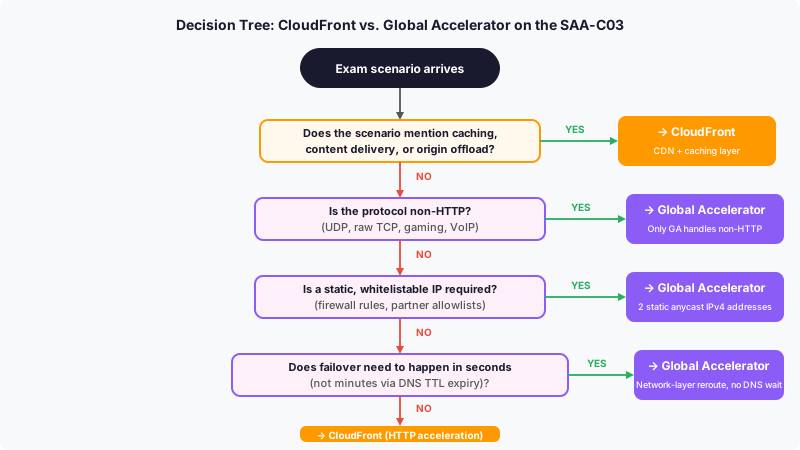
The path through the tree is intentionally sequential. Answer caching first (most common CloudFront use case), then protocol, then static IP, then failover speed. If none of the Global Accelerator triggers fire, you're looking at a CloudFront scenario.
How This Connects to Other SAA-C03 Topics
The CloudFront vs. Global Accelerator decision doesn't live in isolation on the exam. It overlaps with several patterns you should already know:
- SQS vs. SNS vs. EventBridge — like that messaging triangle, these two edge services share a category name ("edge delivery") but are not interchangeable. The same "read the whole scenario for the real requirement" skill applies.
- Security Groups vs. NACLs — both protect your VPC but at different layers. CloudFront and Global Accelerator both sit at the edge but at different layers. The exam's habit of pairing services-that-look-similar is consistent across domains.
- Route 53 — for multi-region failover questions, Route 53 failover routing is a third option alongside Global Accelerator. The differentiator: Route 53 failover is also DNS-based (shares the TTL-propagation limitation); Global Accelerator is network-layer and faster. When the SLA is tight, Global Accelerator wins.
Practice Until the Pattern Fires Automatically
The CloudFront vs. Global Accelerator distinction reads clearly in a blog post. On exam day, under a two-minute timer, the question buries the decisive detail ("UDP," "static IP," "30-second failover") in a long scenario paragraph alongside plausible but irrelevant details designed to distract you. The only way to make the right call automatically is to work through realistic scenario questions until your mental pattern-matcher fires before you finish reading the stem.
The free SAA-C03 practice questions include networking and edge scenarios that test exactly these distinctions — including questions that present CloudFront and Global Accelerator as answer choices in the same question. Run through them and pay particular attention to which detail in the scenario locks in the answer. That's the detail you'll look for first on your real exam.
Not sure whether networking is your weak spot? Take the free 10-question diagnostic — no signup required — and find out in under ten minutes which domains need the most attention before you sit.