Transit Gateway vs VPC Peering: The SAA-C03 Networking Decision Explained
Transit Gateway and VPC Peering both connect VPCs — but they scale differently, cost differently, and answer completely different exam scenarios. Here's the complete guide to getting this right every time on the SAA-C03.
Here is a scenario you will see on the SAA-C03:
A company has 12 VPCs spread across three AWS accounts. They need all VPCs to communicate with each other and with an on-premises data centre over a single AWS Direct Connect connection. What is the most operationally efficient architecture?
Three of the four answer choices will involve some combination of VPC Peering, Transit Gateway, and Direct Connect. If you don't know precisely what Transit Gateway does that VPC Peering cannot — and why the word "12" and the phrase "single Direct Connect" are the two clues that lock in the answer — you're going to second-guess yourself.
This post explains the architectural difference, the cost tradeoff, and the five exam scenarios where each service is unambiguously correct.
The core idea: point-to-point vs hub-and-spoke
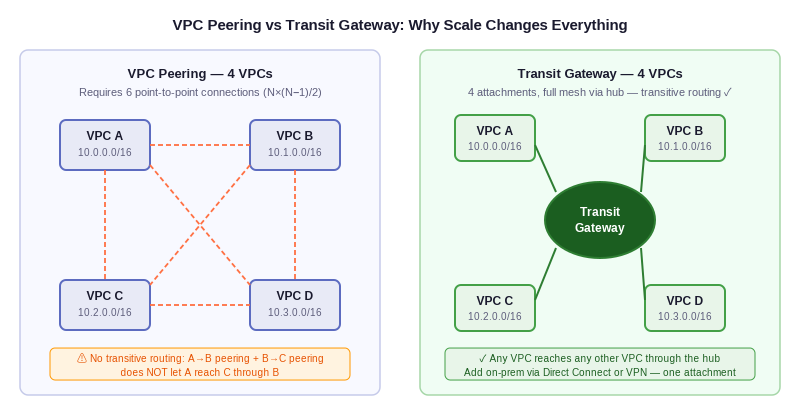
VPC Peering creates a direct, private networking connection between exactly two VPCs. It uses AWS's existing infrastructure — not a gateway, not a VPN — and traffic never leaves the AWS backbone. Each pair of VPCs that needs to communicate gets its own peering connection.
Transit Gateway is a regional network transit hub. VPCs, VPN connections, and Direct Connect gateways all attach to the Transit Gateway as "spokes." The gateway routes traffic between any two spokes. Add a new VPC? One new attachment, and it can reach every existing spoke.
The difference sounds administrative, but it has a hard architectural consequence.
The rule that decides half the exam questions: transitive routing
VPC Peering does not support transitive routing. This is the single most important fact for the SAA-C03.
Here is what that means in practice. Suppose you have three VPCs:
- VPC A is peered with VPC B.
- VPC B is peered with VPC C.
Can an instance in VPC A send traffic to an instance in VPC C, via VPC B?
No. A direct peering connection between A and C is required. VPC B cannot act as a relay.
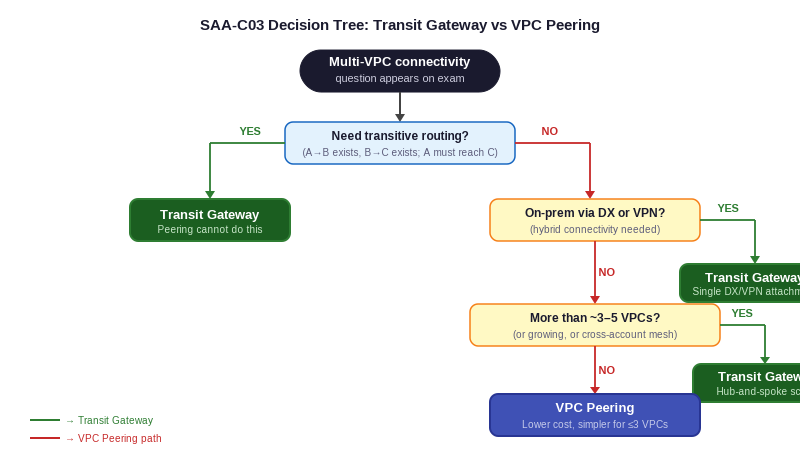
Transit Gateway eliminates this constraint. Any VPC attached to a Transit Gateway can communicate with any other attached VPC — the Transit Gateway handles the routing. This is what "transitive routing" means and why it is the first question in every decision tree.
The exam exploits this in several ways:
- A scenario with three VPCs where "shared services" in one VPC must be reachable from both others — this requires either a full mesh of peering connections or a Transit Gateway.
- A scenario where an on-premises network needs to reach multiple VPCs through a single Direct Connect — this is Transit Gateway territory, because VPC Peering cannot propagate on-premises routes transitively.
- A scenario where the word "hub" or "centralised" or "single point of connectivity" appears — these are almost always Transit Gateway answers.
The scale problem with VPC Peering
VPC Peering scales as N×(N−1)/2. That is the number of connections you need for a full mesh of N VPCs:
| VPCs | Peering connections needed | TGW attachments needed |
|---|---|---|
| 2 | 1 | 2 |
| 3 | 3 | 3 |
| 5 | 10 | 5 |
| 10 | 45 | 10 |
| 20 | 190 | 20 |
Each peering connection also requires route table entries in both VPCs. At 10+ VPCs, managing this becomes a full-time operational problem. At 45 connections, it's untenable.
Transit Gateway supports up to 5,000 VPC attachments per gateway, all managed through centralised TGW route tables. The SAA-C03 will give you a number of VPCs (usually ≥ 5) as a signal that peering is the wrong answer.
Hybrid connectivity: on-premises to multiple VPCs
This is the scenario where Transit Gateway has the most dramatic advantage over peering.
With VPC Peering, there is no way to extend a peering connection to an on-premises network. Each VPC that needs to communicate with on-premises needs its own Direct Connect or VPN connection.
With Transit Gateway, you create a single Direct Connect gateway attachment (or Site-to-Site VPN attachment) to the Transit Gateway. Every VPC attached to the TGW then gains on-premises connectivity automatically — no additional Direct Connect connections required.
The exam scenario looks like this: "A company has 8 VPCs and needs to connect them all to an on-premises data centre. The network team wants to minimise the number of VPN tunnels." Transit Gateway wins because one VPN → TGW gives all 8 VPCs connectivity. VPC Peering cannot do this at all.
For more on the Direct Connect side of this decision, see Direct Connect vs VPN.
When VPC Peering is the right answer
The exam also tests the case where peering is correct — typically when the scenario signals:
- Two specifically named VPCs that need to communicate privately. No mention of transitive routing, no on-premises network, no scale requirement.
- "Lowest cost" with high data transfer. VPC Peering has no per-attachment hourly cost. For two VPCs exchanging large volumes of data within the same AZ, peering is free for the data transfer. Transit Gateway charges per-GB processed plus per-attachment-hour.
- Same-AZ data transfer. VPC Peering traffic that stays within a single Availability Zone is free. Cross-AZ and cross-Region traffic uses standard EC2 data transfer rates. Transit Gateway always charges the data processing fee regardless of where the VPCs are.
- Simple, isolated connectivity. If the exam explicitly frames the requirement as "two VPCs, same Region, same account, no future growth," peering is simpler to set up and cheaper to run.
The pattern to watch: if the scenario says "lowest cost" and describes exactly two VPCs or a small number with no hybrid/transitive requirement, choose peering. If the scenario says "operationally efficient" or "simplify connectivity" across many VPCs, choose Transit Gateway.
The five SAA-C03 scenario signals
| Scenario signal | Answer |
|---|---|
| "Transitive routing" / A reaches C through B | Transit Gateway |
| "Single Direct Connect / VPN to multiple VPCs" | Transit Gateway |
| "10+ VPCs" / "growing number of VPCs" | Transit Gateway |
| "Hub-and-spoke" / "centralised connectivity" | Transit Gateway |
| "Two VPCs, lowest cost, same AZ, no on-prem" | VPC Peering |
If you can pattern-match to this table under exam pressure, you'll get every transit-connectivity question right.
Cost: the honest comparison
VPC Peering:
- No charge to create a connection
- Intra-AZ data transfer: free
- Cross-AZ data transfer: standard EC2 rates (~$0.01/GB each direction)
- Cross-Region data transfer: varies by Region pair (see Amazon EC2 pricing)
Transit Gateway:
- Per-attachment charge (hourly, per attached VPC, VPN, or DX gateway — see Transit Gateway pricing)
- Data processing charge per GB that flows through the TGW
- No free tier for intra-AZ — the processing fee applies regardless
For two VPCs exchanging 1 TB/month in the same AZ: peering costs $0, TGW costs the attachment hours plus ~$20 in data processing. For 20 VPCs with an on-premises network: TGW's operational simplification far outweighs the cost premium. The exam will make the right answer obvious by giving you one of these extremes — the question is recognising which one you're looking at.
Exam cheat sheet
Always Transit Gateway when you see:
- Transitive routing (stated or implied by topology)
- Direct Connect gateway or VPN feeding multiple VPCs
- Five or more VPCs needing full connectivity
- "Centralised egress" or "centralised inspection" (security appliance in one VPC)
- Cross-account shared services that many VPCs consume
Always VPC Peering when you see:
- Exactly two named VPCs, same Region
- "Lowest cost" + no on-prem requirement
- High intra-AZ traffic volume between two VPCs
- Simple, one-off cross-account private connectivity
Never: confuse VPC Peering with PrivateLink. VPC Peering shares the entire VPC CIDR; PrivateLink (Interface VPC Endpoints) exposes a single service. If the scenario says "expose only one service from VPC A to VPC B," that is likely PrivateLink, not peering. See VPC Endpoints: Gateway vs Interface for the full breakdown.
Practice under exam conditions
Understanding the distinction is one thing; applying it to 65 questions in 130 minutes under pressure is another. The free SAA-C03 diagnostic on CertCoach includes networking questions in this exact scenario format — Transit Gateway, VPC Peering, PrivateLink, and Direct Connect all mixed together the way the real exam does it. No sign-up required.
For comprehensive practice, CertCoach's SAA-C03 adaptive mock exams build a per-domain model of where your gaps are, so you spend your remaining study time on the domains that actually need it — not re-reading topics you've already mastered.
AWS documentation: Transit Gateway · VPC Peering · Transit Gateway pricing